

When Geometry Illuminates the Room
A new lamp from Istanbul does something rare

A few days ago I came across a lamp, made in stone.
The object is called Sukun — Arabic and Turkish for tranquility, stillness — and it’s the work of Ibrahim Fatih Satilmis, a designer based in Istanbul. The lamp is made from travertine, a limestone formed over millennia from mineral-rich spring water, full of natural voids and veins. Into a disc of this stone, Satilmis has cut a single Islamic geometric pattern using waterjet and CNC machining. The collection comes in six versions, each carrying a different motif sourced from a specific building: Konya, Kayseri, Karaman, Córdoba, Valladolid, Granada. You choose your pattern; you choose your place.
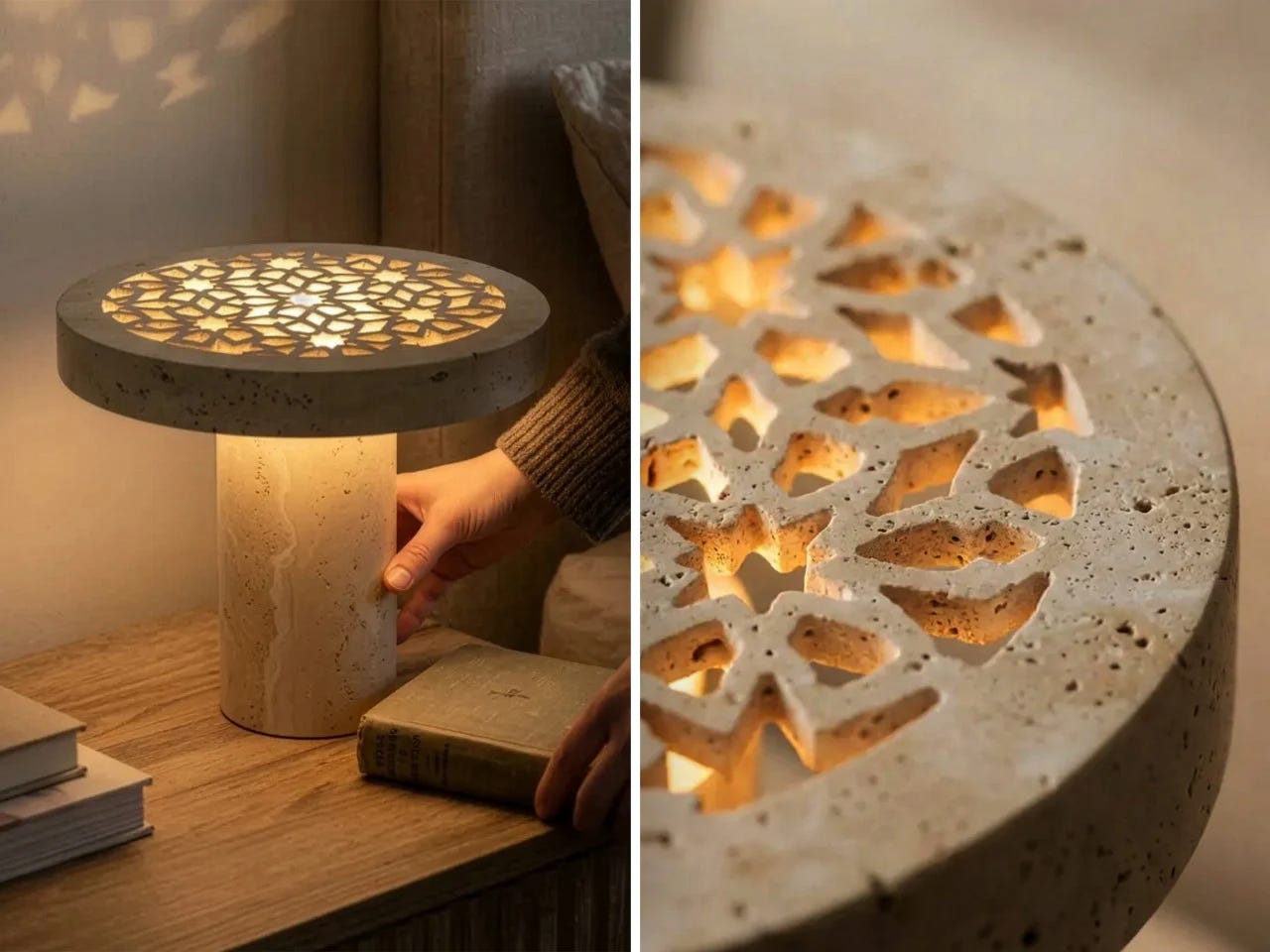
When the lamp is off, it’s a serious piece of stone craft. When it’s on, the geometry is cast outward across the ceiling, the walls, the table below. The room becomes the pattern.
This is something the builders of the original buildings understood instinctively. In Islamic architecture, geometry is never only about the surface. The point is transformation: you step into a space and feel differently inside it. Light and pattern worked together. The geometric tile walls of the Alhambra, the muqarnas vaulting of the Sheikh Lotfollah Mosque — these were not decoration. They were the experience of the building.
What Satilmis has done is compress that principle into an object you can put on your bedside table. Travertine has a texture that catches and holds light unevenly, which means the projected shadows carry some warmth and irregularity. A laser-cut metal shade would give you perfect geometry. The stone gives you something closer to the real thing.
I was pleased to learn that Satilmis used my books to ensure each motif was mathematically faithful to its source building before committing it to stone. These patterns are systems, not ornaments, and that kind of rigour matters.
Sukun just picked up an A’ Design Award in lighting. I hope it finds the audience it deserves.